The ring has always occupied a sacred space in the world of silver artistry, serving as a concentrated canvas for the most intricate techniques a master smith can perform. At Margjelo, the evolution of the filigree ring is a journey that spans millennia, originating from the ancient jewelry traditions of the Mediterranean and the Balkans, where a ring was often more than a decorative band; it was a signet of identity and a protective talisman. Historically, these rings were characterized by heavy silver frames housing dense, hand-twisted wires that formed robust geometric patterns or singular rosettes. In the traditional workshops of Shkodra, the ring was the ultimate test for an apprentice, requiring the ability to manipulate silver threads in a circular, three-dimensional space where even the smallest error in symmetry would be immediately visible to the eye.
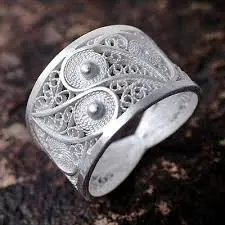
As we move into the 21st century, the design language of the filigree ring has transformed to meet the aesthetic demands of the modern woman, shifting toward a lighter, more ethereal silhouette. Modern iterations at Margjelo focus on a "less is more" philosophy, where the air between the silver threads is as important as the metal itself. We have moved from the solid, shield-like rings of the past to delicate, lace-like bands that seem to float on the finger, highlighting the skin beneath the silver lattice. This evolution allows the ancient art of hand-soldered wires to pair effortlessly with contemporary fashion, from professional attire to evening wear. While the silhouettes have changed to become more minimalist and ergonomic, the core technique remains unchanged—each ring is still forged from raw silver and meticulously filled with hand-curved spirals that pay homage to our Illyrian roots.
The contemporary filigree ring serves as the perfect bridge between historical significance and modern self-expression. Today’s designs often feature open-ended bands or asymmetrical floral arrangements that offer a fresh perspective on traditional motifs like the sun or the vine. By refining the scale and the weight of these pieces, Margjelo ensures that the heritage of Shkodra is not something kept behind museum glass, but something that can be worn and enjoyed every day. This evolution proves that the art of the silver thread is not a static relic; it is a living, breathing craft that continues to reinvent itself. When you wear a modern filigree ring, you are wearing five thousand years of history distilled into a sophisticated, hand-crafted circle that honors the past while looking firmly toward the future.

 Luledele